COLUMBUS, OHIO — The National Center for the Middle Market (NCMM) reports that the U.S. middle market stabilized toward the end of 2025, showing signs of cautious improvement rather than a full rebound.
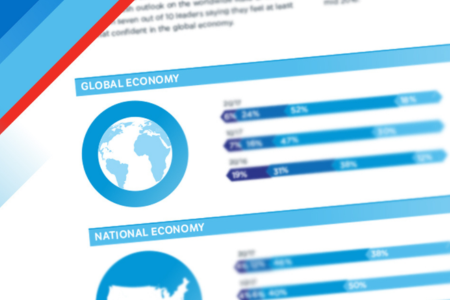
After slowing mid-year, revenue growth picked up in the fourth quarter, hiring demand remained steady and overall economic confidence held roughly flat compared to Q2. Confidence in the global economy edged higher, suggesting modest optimism even as uncertainty persists.
According to NCMM’s Middle Market Indicator (MMI), average year-over-year revenue growth reached 11.7% in Q4 2025, up from 10.7% earlier in the year. Employment growth also increased slightly, rising to 7.8% from 7.4%. Confidence levels across local and national economies were largely unchanged quarter to quarter, while global confidence showed a small uptick.
Middle market companies continue to prioritize growth and profitability, with a strong operational focus on customer retention, workforce upskilling and technology upgrades, including ERP and CRM systems and artificial intelligence tools. Expansion plans remain measured. Over the next 12 months, companies are more likely to pursue new products or services and selective entry into new U.S. markets than broad-scale expansion.
Technology investment is increasingly concentrated on intelligence and AI-enabled tools. Most firms are still in the early stages of AI adoption, using it primarily to automate routine tasks and enhance analytics rather than replace workers. Expected benefits include improved operational efficiency, lower costs and better decision-making, while top concerns center on data quality and security, skills gaps and implementation costs.
“We continue to see middle market firms lean more heavily into technology utilization as a means to address productivity and costs,” said Doug Farren, executive director of the NCMM. “Specifically, AI adoption continues to grow, as nearly a third of companies say this is now their primary destination for capital investment.”
At the same time, companies report rising challenges related to technology integration and increased competitive pressure, largely driven by industry peers. Talent retention and hiring remain key priorities, with steady hiring overall and mixed evidence of broad workforce reductions across the middle market.
About the Middle Market Indicator (MMI)
The MMI, which was first launched in 2012, surveys 1,000 CEOs, CFOs, and other C-suite executives of America’s middle market companies on key indicators of past and future performance in revenue, employment, and allocation of cash. The survey also reports middle market company confidence in the global, U.S., and local economies and identifies key business challenge areas. The survey was designed to accurately reflect the nearly 200,000 U.S. businesses with revenues between $10 million and $1 billion, the lower and upper limits of middle market annual revenue. The survey is designed and managed by the National Center for the Middle Market. The most recent survey reflected in this report was fielded in June 2025.
About the National Center for the Middle Market (NCMM)
The National Center for the Middle Market is a research center housed at The Ohio State University Fisher College of Business exists for a single purpose: to ensure that the vitality and robustness of middle market companies are fully realized as fundamental to our nation’s economic outlook and prosperity. The center is the leading source of knowledge, leadership and innovative research on the middle market economy, providing critical data analysis and insights for companies, policymakers and other key stakeholders. The NCMM is fully committed to dynamically creating new knowledge, providing programs that drive value for middle market companies and offering a well-informed outlook on the health and future of the middle market via the Middle Market Indicator. The NCMM and its Middle Market Indicator are generously funded by Chubb, Visa and Wells Fargo.
About The Ohio State University Max M. Fisher College of Business
The Ohio State University Max M. Fisher College of Business provides tomorrow's business leaders with the foundation needed to succeed in business today. Fisher students experience an academically rigorous learning environment, led by world-class faculty, which fosters their development as principled leaders who possess an entrepreneurial spirit, global awareness and a commitment to social responsibility. Organizations from around the globe thrive under the leadership of Fisher alumni, who positively impact their communities and the world.