
Executive Summary
While conditions have improved since the beginning of the year, businesses foresee continued uncertainty and a longer road to recovery.
As the COVID-19 pandemic continues in the United States and the world, the National Center for the Middle Market surveyed 1,000 financial decision-makers in conjunction with its 2Q 2020 Middle Market Indicator survey. We compared the data, collected between June 1 and 12, 2020, with the findings from our 4Q 2019 MMI survey and our March COVID-19 pulse survey of 260 companies.
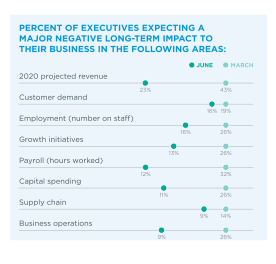
Concern softening
A major negative impact on revenue remains their biggest concern. Hours worked, the second most common concern in March, slipped to fifth place, with customer demand, staff size, and growth initiatives moving ahead.
Across the board, fewer middle market leaders expect negative impacts than in March. This may be because they believe they have taken most of their hits already and see less damage ahead, or it may be that they have revised their March projections upwards, or there was simply too much uncertainty in the early days of the pandemic.
Projected slower growth
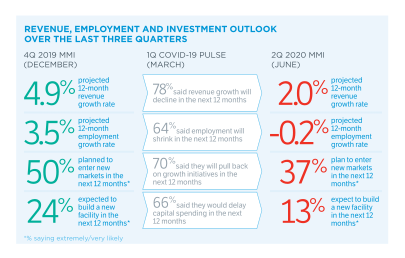
In December 2019 the average projected 12-month revenue growth rate was 4.9%. Looking ahead 12 months from June, executives foresee positive growth, but at less than half the annual rate expected in December of 2019. Employment is likely to continue to fall in the 12 months ahead. Expansion and investment plans are similarly reduced from what they were six months ago.
Uncertainty is high
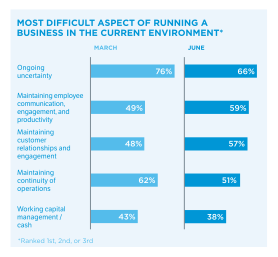
The pandemic catapulted companies into uncharted territory, but many appear to be finding their bearings—or at least gaining knowledge of their obstacles. Three months into the pandemic, executives have a better handle on operations and are beginning to focus on the tasks of getting customers served and work done.
Financing support
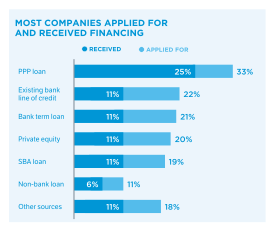
About two-thirds (65%) of respondents sought financing and 56% received it. The federal government’s Paycheck Protection Program was the biggest source, sought by 33% and received by 25%. For smaller firms, PPP was by far the most important source of financing, with 31% receiving relief compared to 10% for the next largest source, the Small Business Administration (SBA).
Long road to recovery
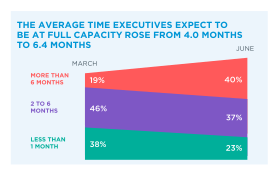
Overall, middle market companies were operating at 67% of capacity as of early June 2020. There were significant variations by industry: Construction was at 80%, retail at 56%, for example. Executives’ timeline for returning to full capacity once the pandemic comes under control has lengthened significantly. Also interesting, more than eight out of 10 middle market leaders say it is likely that their companies will make significant and long-lasting changes in the ways they operate to ensure the health and safety of employees and customers.
About the National Center for the Middle Market
NCMM is the leading source of knowledge and innovative research on the US middle market, supporting its growth, employment and competitiveness. Contact us at middlemarketcenter@fisher.osu.edu or visit us at www.middlemarketcenter.org.
