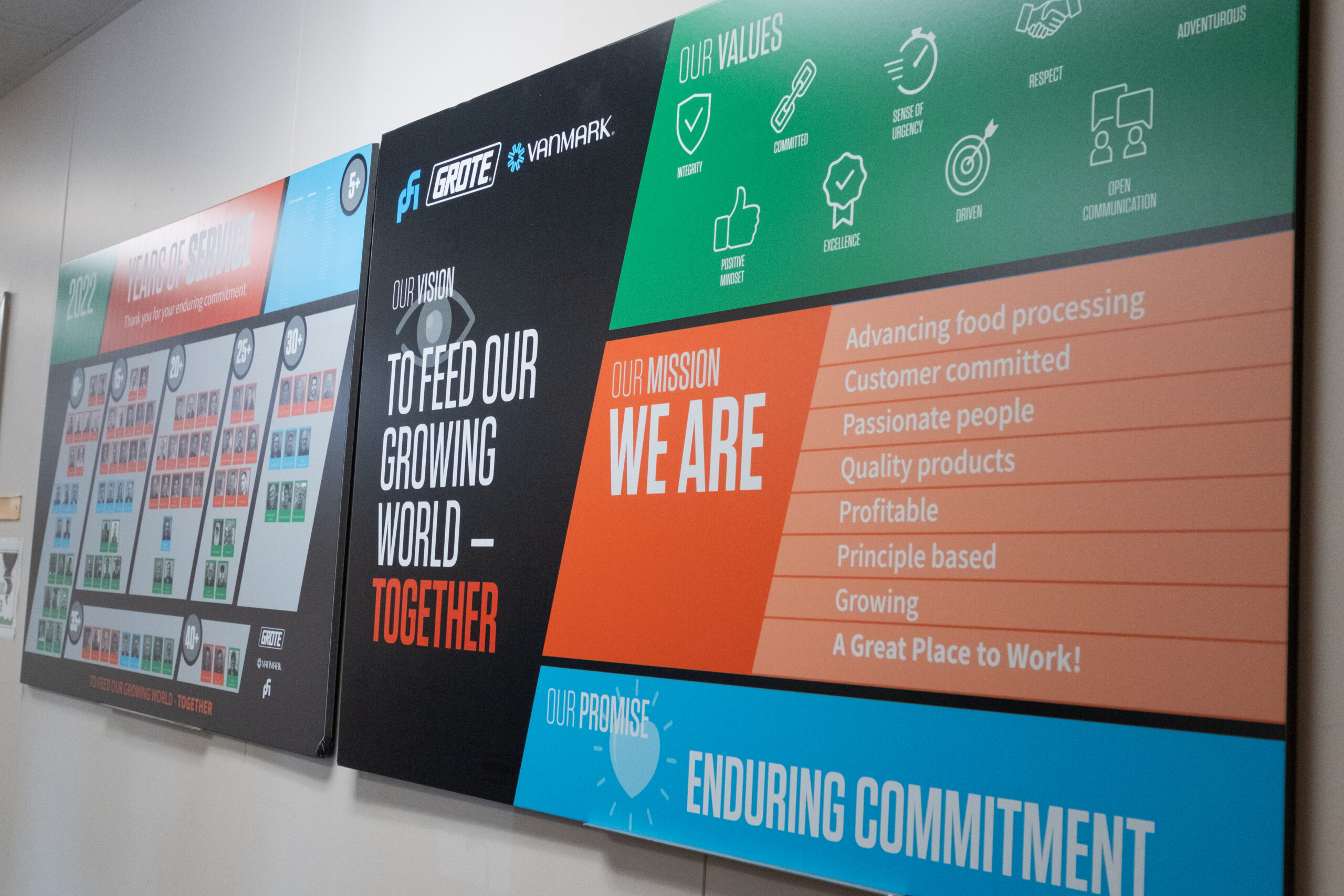
Based in Columbus, Ohio, Grote Company is a U.S. mid-sized manufacturer of custom industrial food slicing and assembly equipment and a provider of parts and services for the food manufacturing industry. The company opened its doors in 1972 and began serving its first international customers in the late 80s when it established a sales office in the United Kingdom.
Since then, the company has solidified its position as a global leader in its industry. With a corporate mission of feeding a growing world, Grote Company has established a major global footprint through multiple acquisitions and the opening of additional new facilities in India and the Netherlands.
Overview
Middle market companies are largely domestic entities. Middle Market Indicator (MMI) data reveal that, on average, 86.5% of all middle market revenue comes from the United States. Nevertheless, approximately one out of five middle market companies engages in some type of international expansion every year. The National Center for the Middle Market’s 2024 report on Purchasing and Selling Abroad reveals that revenue growth is the number one advantage motivating middle market companies to venture beyond American shores in search of customers. Yet, with that growth comes significant challenges: seven out of 10 companies with international revenues report contending with supply chain issues, including quality control, trade regulations, tariffs and exposure to risk.
This case study tells the story of one middle market company that has overcome challenges to build a robust international business. By fully committing to its international customers and maintaining a local presence to ensure the best possible service in each market, the company now earns approximately 50% of its food processing equipment division revenues from overseas business.
The Opportunity
Tap a Growing International Market to Pave the Way to Future Revenue Growth
Grote Company’s very first customers were frozen pizza producers in the United States. But Americans are far from the only ones to love the convenience of a ready-to-heat meal. In the late 80s, the European frozen pizza market began coming into its own, and Grote Company started to receive inquiries from United Kingdom-based companies. A relationship grew with a local U.K. dealer, and Grote Company enjoyed the occasional international sale.
However, company leaders soon realized that they were capitalizing on only a very small slice of the European market. With the right strategy and approach, Grote Company could fully tap the increasing demand and create a path to continued strong revenue growth for the company. This would require a bigger commitment beyond partnering with a local dealer—Grote Company needed to establish its own strong presence in the market to win business and serve the needs of its growing European customer base.
My major multinational customers would not deal with me if I couldn’t support them and be in the countries where they operate.”
Bob Grote
Grote Company Chief Executive Officer
The Approach / Solution
Make a Strong Commitment to International Expansion with an Emphasis on Close Proximity to International Customers
Grote Company committed to going all in on the opportunity in Europe. The four key pillars of its successful globalization strategy included:
Put Feet on the Street
The company’s customized equipment, with each piece designed to fit the customer’s requirements and existing systems, demands direct, face-to-face sales and first-hand knowledge of each customer’s unique environment. “We needed feet on the street to capture the opportunities and really work the business,” explains CEO Bob Grote. So, in 1989, Grote Company established a greenfield sales office in the U.K. As the company gained more traction in Europe, it added a service and parts operation in the early 90s to ensure its customers had quick, convenient and affordable access to face-to-face aftermarket support. The company eventually established light manufacturing operations in the U.K. as well. Years later, in response to Brexit, Grote Company opened a second European distribution facility in the Netherlands to support its European Union customers and help them avoid the cost and hassle of importing from the U.K
Hire Local Expertise and Grant Local Autonomy
While it was critical for Grote Company to establish its brand in the European markets and ensure customers access to the “face of Grote,” company leaders knew they lacked the knowledge of local preferences, culture and regulations needed to successfully run the day-to-day business operations. “The nuances of the different kinds of food, how the foods are distributed, the cold chain to distribute those foods and the regulations—it’s all different over in Europe. Not to mention all the different languages and currencies. You have to hire that knowledge,” explains Grote.
The company’s first strategic international hire involved recruiting its local distributor to join the company and head up European operations. Grote Company gave its new leader the budget and autonomy to hire his own staff and make critical business decisions. With minimal oversight and guidance from U.S. headquarters, the new European division president had the authority he needed to navigate the daily challenges and take advantage of the opportunities, such as expanding beyond the pizza market to tap into the growing sandwich market in Europe. The approach not only prevented a drain on U.S. resources, but it also positioned the new European business to achieve its full potential.
Learn from Mistakes
While Grote Company did many things right in establishing its first international operations, growing pains are inevitable. The key is to learn from the experience and apply the lesson to the next opportunity. In the company’s case, the most expensive mistake in the European operations involved attempting to set up fully vertically integrated manufacturing in Western Europe. “There are a lot of folks out there that can bend metal and machine metal. If you find your suppliers and there is a big supplier base to provide the hard goods, then you can do the final assembly and you are much more flexible that way,” says Grote.
Similarly, Grote Company also learned the hard way that it often makes more sense to buy than build when it comes to technologies. While Grote Company successfully built its own robotics capabilities from the ground up in its European operations, the investment of both time and money was steep. The company later purchased the same technologies for its U.S. operations at a fraction of the cost to build the capability in Europe.
Repeat and Adapt
Having achieved success in Europe, Grote Company took what it learned from the experience and turned its attention to the East. While China was a contender, the company ultimately decided to expand into India largely based on the political climate and less governmental involvement in business. Grote Company leveraged its playbook from Europe and once again hired an existing local distribution partner to head up its new operations and help fully tap the enormous market opportunity in the country of 1.4 billion people.
Recalling its early manufacturing headaches in Europe, Grote Company found a great local supplier base. While its in-house manufacturing capabilities are more robust in India than in Europe, the primary focus remains on the final product assembly, which is where Grote Company delivers the greatest value to its customers.
While Grote Company has clearly established an international playbook framework with strategies it can successfully deploy in different markets, flexibility is key as cultures, regulations and expectations vary greatly from one market to the next. “That’s another reason why you can’t be centrally dominated when you’re an international company. The way different markets will do things will sometimes be dramatically different than what you are used to or how you’ve done them before. But if you want to grow there, you have to be willing to roll with it,” added Grote.on Details
The Results
Half of Food Processing Equipment Division Revenue Now Comes from Overseas
For Grote Company, the decision to establish a new sales office overseas based on a handful of existing customers and a hunch that the European frozen pizza market was about to take off was a bold move. But it has paid off by more than meeting the company’s expectations for growth and establishing the company as a clear global leader in the industry. It is now well on its way to becoming the billion-dollar company its leaders envision with operations in every country where its customers operate.
We didn’t really have much at all in the way of international sales 25 to 30 years ago. To build it up over time, where it’s such an important part of our business today— about half of our overall food processing equipment revenues—I consider that a victory and a big success.”
Bob Grote
CEO
Results at a Glance
~50%
Of total food processing equipment division revenue from overseas customers
2.5x
Expansion to U.K. facilities to accommodate current and future growth
10
Total locations, including operations in the U.K., India and the Netherlands