

Executive Summary
The National Center for the Middle Market (NCMM) has studied the U.S. middle market economy since 2011, creating the world’s largest and richest dataset on this critical economic segment. As the closest neighbor to the U.S., Canada enjoys an interconnected economic relationship with the U.S. based on significant cross-border trade and investment. Given the importance of this relationship, NCMM, in collaboration with Visa, set out to better understand the Canadian middle market and how it compares to and differs from the U.S.market across various key performance indicators.
This research verifies the interdependence of the two markets: Canadian middle market companies rely on the U.S. for approximately 20% of their revenues. Further, most Canadian middle market companies (58%) source at least some goods and materials from the U.S.
In addition, this study confirms that Canadian middle market companies are performing just as well as, and even slightly better than, their U.S. counterparts, underscoring the importance of the middle market sector to the Canadian economy. Canadian middle market companies report healthy year-over-year revenue and employment growth. Leaders’ economic confidence levels are high, and the outlook is positive.
However, Canadian middle market companies face significant headwinds to growth, including concerns related to inflation and staffing shortages. While digitization is increasingly important to ongoing growth and companies are prioritizing investments in digital solutions, they lag U.S. companies in key areas, including integration of artificial intelligence (AI) into the business. To facilitate revenue growth and financing of operating expenses, Canadian middle market companies are heavy users of card products, and payments may be a key area for further investment in digital business solutions.
As the inaugural Middle Market Indicator for the Canadian middle market, this report provides the first comprehensive business performance overview and economic outlook for this sector and offers data and insights that can be used to benchmark future performance of the Canadian middle market economy.
How the research was conducted
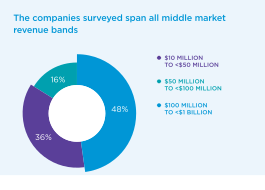
The report includes the findings of a survey fielded in June 2024 to 300 CEOs, CFOs and other C-suite executives of Canadian middle market companies on key indicators of past and future performance in revenue, employment and allocation of cash. The survey also reports middle market company confidence in the global, Canadian and local economies; identifies key business challenge areas; and explores trends in digitization and payments. The companies surveyed span all middle market revenue bands: $10 million to less than $50 million in annual revenues (108 companies), $50 million to less than $100 million in annual revenues (50 companies) and $100 million to less than $1 billion in annual revenues (144 companies). On average, the companies surveyed have been in business for 27 years and employ 1,200 employees. They primarily operate in the manufacturing, insurance and financial services sectors. For comparison purposes, this report references U.S. middle market data from the Mid-Year 2024 Middle Market Indicator.
Key Insights
Canadian Middle Market Performance
Lower middle market companies drive Canada’s robust middle market performance.
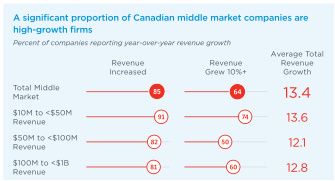
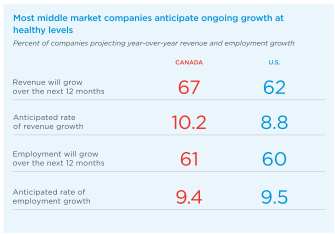
Overall, Canadian middle market performance is extremely strong, with around three-quarters of Canadian middle market companies believing their organizations are faring better today compared to one year ago. Nearly all companies (85%) report year-over-year revenue growth. Notably, the Canadian middle market boasts a significantly greater proportion of high-growth companies (companies growing revenue at 10% or more year-over-year) than the U.S. (64% compared to 58%), which contributes to the nominally higher average rate of year-over-year revenue growth in Canada (13.4% compared to 12.9%).
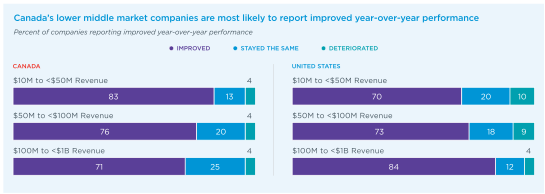
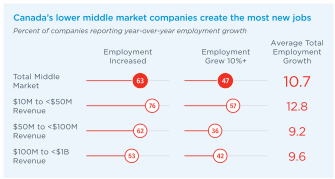
Canada’s lower middle market companies (annual revenues between $10 million and less than $50 million) stand out as the strongest performers within the economic segment. They are significantly more likely to report improved performance than larger middle market companies. Similarly, they are significantly more likely than their larger peers to report high revenue growth of 10% or more year over year, and they report the highest rate of employment growth. Overall, nearly two-thirds of Canadian middle market companies increased the size of their workforces between June 2023 and June 2024 at an average rate of employment growth of 12.8%, with the lower middle market firms leading the way in job creation.
Interestingly, the performance story is flipped in the U.S. Historically, the largest U.S. middle market companies (annual revenues between $100 million and less than $1 billion) consistently demonstrate the strongest revenue and employment growth numbers reporting period after reporting period.
Middle Market Outlook
An optimistic outlook, along with healthy confidence levels, points to continued growth for the Canadian middle market.
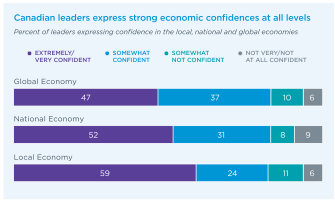
Most Canadian middle market leaders expect continued strong revenue and employment growth over the next 12 months. Economic confidence levels reflect this optimistic outlook. Overall, Canadian business leaders are significantly more confident in their own national economy, as well as the global economy, compared to their U.S. peers. This may be a function of Canada’s considerably smaller economy as well as its reliance on the U.S. economy as a major source of revenues and materials.
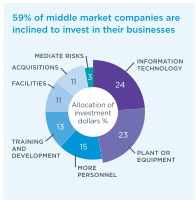
Canadian middle market leaders are more likely to invest an extra dollar in their businesses immediately than to save it. Most savers are saving for future investments as opposed to stockpiling for a rainy day. Technology, people and capital expenditures are key areas for investment.
Challenges and Risks
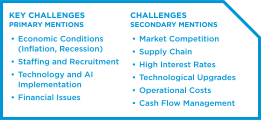
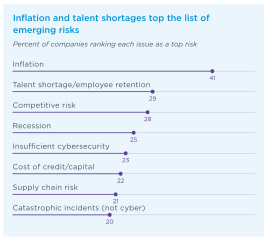
Inflation tops the list of challenges for Canadian middle market leaders followed by difficulties in keeping their growing companies staffed.
Despite strong growth and a healthy outlook, Canadian middle market leaders face many of the same challenges as their U.S. peers.
Economic Challenges
When asked about the challenges likely to have the biggest impact on a company’s performance over the next 12 months, economic conditions such as inflation, recession and volatile economic environments received the most mentions. Leaders are specifically worried about the costs of supplies, salaries and overall expenses as well as how to maintain profit margins in uncertain times.
Talent Challenges
Staffing and recruitment issues come in a close second. Leaders mentioned challenges such as attracting and retaining talent, addressing skill gaps, recruiting specialized roles, maintaining employee morale and reducing turnover. While the Canadian middle market has been generating new jobs at the healthy rate of 10.7% over the past 12 months, nearly a quarter of companies (22%) say they currently do not have enough people to meet market conditions.
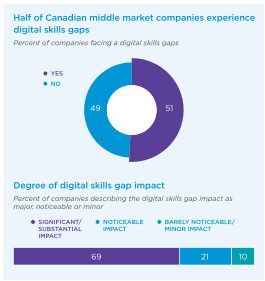
Whether companies are filling vacancies or hiring to support ongoing growth, more than three-quarters of companies (76%) say it is at least somewhat difficult to find people with the right skills, and most of these businesses say it is very or extremely difficult to hire qualified people. Digital skills especially are in high demand, as 94% of companies say such skills are important or even critical to the success of their businesses. Yet half (51%) of Canadian middle market companies face a digital skills gap, and this digital skills gap seems to have an even greater detrimental impact on Canadian companies than it does on U.S. businesses: Approximately seven out of 10 Canadian middle market companies facing a digital skills gap admit it has a significant or substantial impact that limits or slows the growth of the company.
Digitization Challenges
While inflation and staffing are the most mentioned challenges and rank the highest when it comes to emerging risks, Canadian middle market leaders also recognize the many challenges posed by operating in the digital era. AI is, of course, top of mind as it is for companies of all sizes and in all places. Leaders are focused on how to integrate AI into existing workflows, how to train employees to use new technology and how to keep up with rapid technological advancements. Ensuring data privacy is yet another major concern, and, not surprisingly, cybersecurity ranks in the top five emerging risks for Canadian middle market businesses.
Financial Challenges
Canada’s middle market leaders face a variety of financial challenges, ranging from effectively managing debt and high interest rates to securing additional investment for growth, managing cash flow and balancing operational expenses with revenue. Nearly a quarter of companies (22%) cite the cost of credit and capital as an emerging risk. However, only 16% see access to credit and capital as a major headwind to growth.
Digitization
Most Canadian middle market companies prioritize a more digital future.
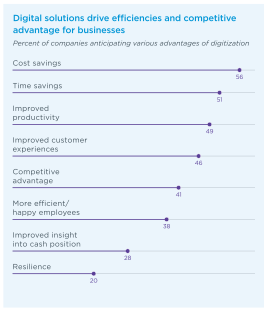
Canadian midsize businesses recognize the importance of digitization and understand the advantages that come with strategic investments in technology. Gaining efficiencies—including cost and time savings along with increased productivity—is the primary motivator for investing in digital innovation. Many companies also view digitization as a means of improving customer and employee satisfaction. For two out of five companies, investment in digital solutions is seen as a catalyst for developing a competitive advantage in the marketplace.
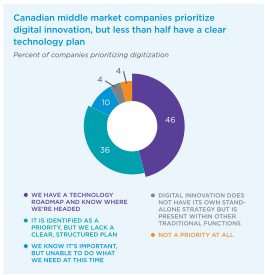
While the importance of digital innovation is well established and appears to be a priority for most businesses, Canadian middle market companies are in an earlier stage of the digitization journey than U.S. companies. They may be somewhat less prepared to embrace a more digital future. For example, currently, less than half (46%) of Canadian middle market businesses claim to have a technology roadmap in place.
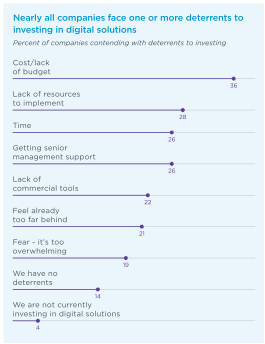
Whether companies know where they are headed digitally or are still working on a structured plan, the vast majority of companies face one or more deterrents to investing in new technologies. These headwinds primarily include lack of budget, resources, time and/or senior management support.
Card Utilization
Digital solutions and card products in particular are key to facilitating Canadian middle market business transactions.
Nearly every Canadian middle market business uses some sort of digital accounts payable solution, presumably to create efficiencies and ensure accuracy of corporate finances. While 16% of companies indicate that they use a combination of paper and Excel to keep the books—almost twice as many as in the U.S.—most businesses use one or more financial software products.
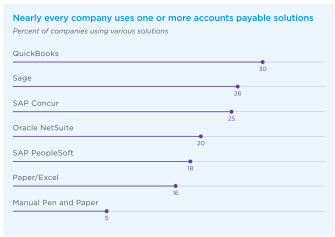
QuickBooks is the most popular solution among Canadian middle market businesses. SAP and Oracle solutions are also used by many companies, with the largest middle market businesses significantly more likely than smaller businesses to use SAP Concur.
Overall, Canadian companies—and especially the largest middle market businesses—are much more likely to use Sage than their U.S. peers: In Canada, Sage is the second most used solution, with more than a quarter (26%) of middle market companies leveraging the software.
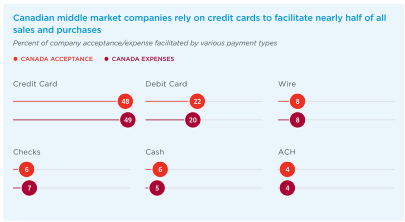
Canadian Middle Market businesses are heavy card users overall for both sales and expenses
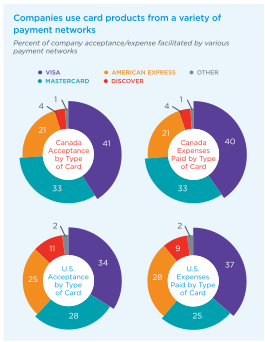
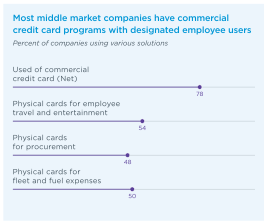
In Canada, credit cards are the most popular form of payment for both sales and expenses, accounting for nearly half of transaction volume. The vast majority of middle market companies (78%) use physical commercial credit cards for purposes including procurement, travel and entertainment, and fleet and fuel expense management. On average, around a third of employees use these cards.
Artificial Intelligence
Companies are exploring AI, but few have embedded the technology in the business.
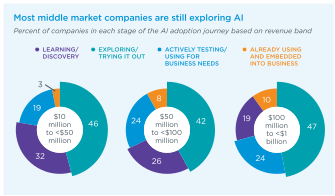
Four out of five Canadian middle market companies believe AI is a good thing for business, whether or not they are already using the technology. Most companies, and smaller middle market companies especially, are still testing the waters when it comes to how to leverage AI to their greatest advantage. While few middle market companies have yet to fully embed AI into their businesses, Canadian companies lag their U.S. peers in the overall AI adoption and integration journey: U.S. companies are twice as likely as Canadian companies to indicate that they are actively using AI. This may be a function of a more cautious, risk-averse mindset among Canadians in general.
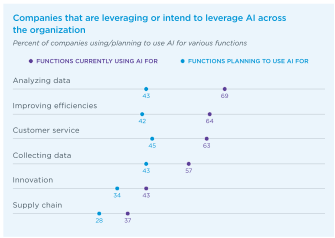
Where Canadian middle market companies are already using AI, they are primarily using it for analyzing data, improving efficiencies and customer service. Indeed, customer service is one area in which Canadian companies are ahead of their U.S. counterparts, and Canadian companies plan to keep that lead. Customer service is the top area cited for future AI usage, followed by analyzing and collecting data.
In whichever ways Canadian companies are already using or plan to use AI, many express a variety of concerns related to AI adoption, ranging from security and privacy to accuracy and reliability considerations and to worries over job displacement and ethical and legal issues. Some leaders cite integration and implementation challenges, while others mention the need for oversight, governance and parameters to ensure AI is used in responsible and beneficial ways. Further, most companies face one or more deterrents when it comes to implementing AI, including security issues, the complexity of the technology, and a lack of budget and resources.
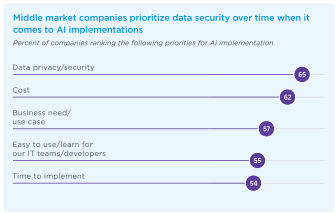
Given the overall AI landscape, including hurdles to adoption and expected benefits, Canadian middle market leaders point to data privacy, cost and the need to establish a clear business use case as the top three considerations for integrating AI into the business.
Center Perspective
In collaboration with Visa, NCMM began collecting key performance indicator data from Canadian middle market companies in 2024. This inaugural Canadian Middle Market report gives a snapshot of overall performance and includes benchmark data that will allow us to monitor ongoing middle market performance in Canada while more fully understanding the larger North American middle market.
On the surface, the initial findings reveal that Canadian middle market performance mirrors U.S. middle market performance across all key indicators, confirming that the middle market represents a vital and powerful segment of the Canadian economy. The vast majority of Canadian middle market companies report strong year-over-year revenue growth, and 63% of companies increased the size of their workforces over the past 12 months. Companies are confident in the economy and willing to invest in growth. However, Canadian middle market leaders contend with the same struggles as their U.S. peers, including concerns related to inflation, difficulties finding skilled talent and the need to keep pace with technological advancement.
A deeper look at the data surfaces some interesting differences between the Canadian and U.S. middle markets, the most significant being the contributions of the smallest Canadian middle market companies. In Canada, middle market companies with revenues between $10 million and less than $50 million—what NCMM calls the lower middle market—are by far the strongest overall performers with the highest revenue and employment growth rates. But in the U.S., the reverse holds true, and the largest middle market companies (revenues between $100 million and less than $1 billion) typically outperform their smaller peers.
Several factors likely contribute to this discrepancy. The smaller overall size of the Canadian economy may require, and even necessitate in some cases, that Canadian businesses internationalize early on, spurring faster scaling among the smaller end of the middle market. Further, strong national policies that support smaller businesses may be providing some tailwinds for the companies on the lower end of the middle market spectrum. Finally, the data shows Canadian middle market companies lag in digitization. A likely explanation, as we’ve seen in the U.S., is that larger companies have the capital and internal resources to invest more heavily in technology.
The NCMM and Visa look forward to continuing to study the Canadian middle market. NCMM plans to report annually on the Canadian middle market, and we are excited to learn what our next round of research contributes to our evolving view of the overall North American middle market.
